Product Ideas
Leather Corporate Gifts: A Buyer's Guide to Branded Gifting
By the India Leather Manufacturer production teamUpdated 14 min read
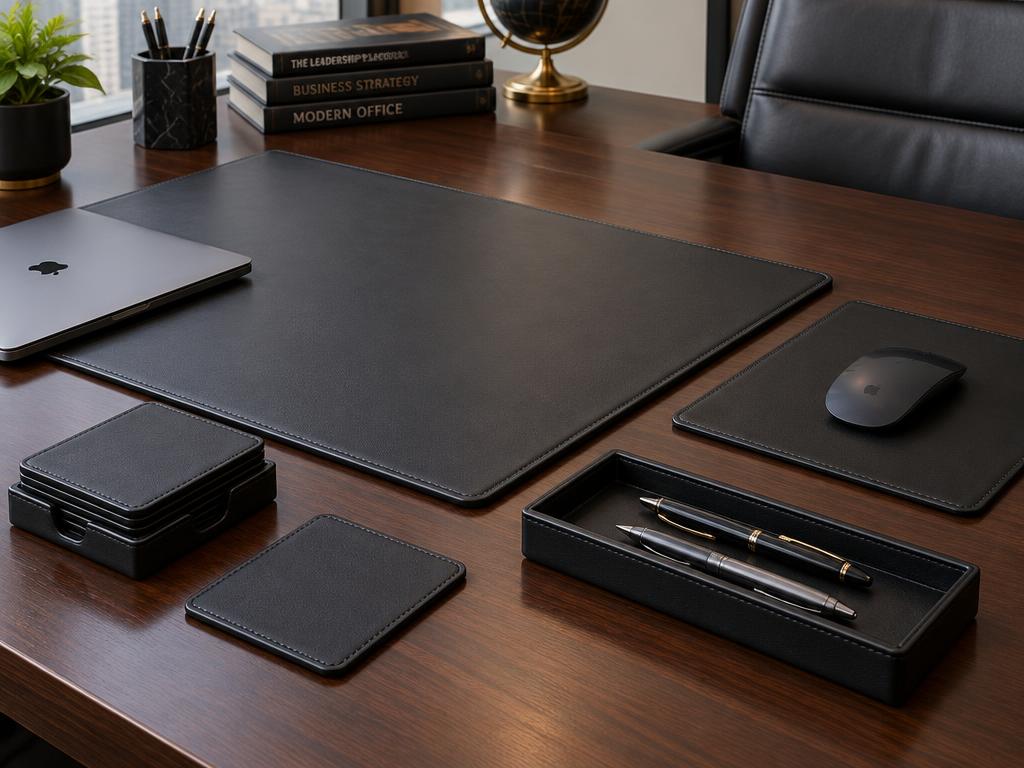
Quick answer
The leather gifts that work are the ones recipients use daily: card holders, wallets, notebook covers, passport holders, desk pieces, laptop sleeves, tech organisers, luggage tags and curated sets. The branding method should be chosen against the leather and the artwork rather than by preference, and individual-name personalisation adds days at the end of the run. Plan backwards from the event date, not forwards from the enquiry.
Key takeaways
- Gifts are judged in the hand and in the first ten seconds. Branding registration and edge finish do more for perceived value than material cost does.
- A gifting programme is a deadline problem. The event date does not move, so the schedule is built backwards from it.
- Individual-name personalisation is added at the end of production, not the start — and a wrong name on a spreadsheet is not a factory defect.
- Sets are a kitting job as much as a making job: every box is counted and checked against the packing specification before it closes.
- One brass die covers every piece in a set that carries the mark at the same size, which is why deciding the branding size early saves real money.
- Festival and Q4 windows are the capacity constraint. Diwali, Ramadan and year-end gifting all compete for the same line slots.
What makes a leather gift actually land
Corporate gifts are evaluated in two moments: the first ten seconds out of the box, and whether the recipient still has it six months later. Those are different tests, and a programme that optimises for only the first produces something that photographs well and ends up in a drawer.
The first test is about presentation and finish. Branding registration — the mark straight, centred where it should be, struck to an even depth — is the first thing anyone notices on a gift item, and an uneven foil or an off-angle deboss destroys the impression regardless of what the leather cost. Edge finish is the second. Both are labour, not material, which is why a well-made piece in a mid-grade leather routinely out-performs a badly made one in a better hide.
The second test is about use. Card holders, wallets, notebook covers, passport holders, luggage tags, laptop sleeves, tech organisers, desk pads and pen holders survive because they do a job. Decorative pieces do not. If the budget forces a choice, choose the smaller useful item over the larger ornamental one.
Choosing pieces for the programme you are actually running
Different gifting programmes have different constraints, and the piece should be chosen against the constraint rather than against a catalogue.
| Programme | Pieces that work | What decides the specification |
|---|---|---|
| Client and partner gifting | Notebook covers, card holders, desk pads, watch rolls, curated sets | Perceived value in the hand and the quality of the presentation box |
| Employee joining kits | Laptop sleeves, tech organisers, notebook covers, keychains | Repeatability across months and a stocked article that can be reordered |
| Conference and event sets | Card holders, luggage tags, pen holders, folders | A fixed date, a fixed quantity and a per-piece budget set by someone else |
| Channel partner and dealer programmes | Wallets, belts, messenger bags, travel pieces | Tiering — several budget levels under one branded identity |
| Hospitality and property | Menu covers, bill folders, room folders, key fobs | Durability in daily service and matching an existing interior colour |
| Awards and recognition | Briefcases, duffels, watch rolls, personalised small goods | Individual-name personalisation and the time it adds at the end |
| High-volume promotional | Keychains, luggage tags, card sleeves, PU wallets | Finding the cheapest credible construction that still reads as premium |
Branding a gift: choosing the method against the piece
On a gift item the mark is the product, so the method deserves more thought than it usually gets. Every method is struck off on your actual leather and colour before production, and the strike-off records the die, the size, the position, the pressure and the temperature so the result is repeatable on next year's programme.
Artwork requirements, which hold up more programmes than anything else
Vector only — AI, EPS, PDF or SVG — with fonts outlined and supplied at final size, single colour for a deboss or a foil. Hairlines and small reversed-out text fill in on leather, so a monogram usually needs around 8–10 mm of width to stay legible and a wordmark considerably more. Send the artwork at the enquiry stage rather than at order confirmation: die making runs 3–5 working days and it is a stage that can be run in parallel with sampling, or serially at the end if the file arrives late.
One die, one size, whole range
A brass die is engraved for one mark at one size and is kept on record. Every piece in a set that carries the mark at that size uses the same die, and so does next year's reorder. Decide the branding size across the whole programme before you order the first die and you tool once; let each piece be decided separately and you tool three or four times for no benefit.
| Method | Best on | Avoid when |
|---|---|---|
| Blind deboss | Vegetable-tanned, full-grain and milled leather from about 1.2 mm up | The leather is soft, loose or heavily grained, or the artwork has hairlines under about 0.5 mm |
| Hot foil | Dark leather where a blind mark would disappear; gift pieces that want contrast | The mark sits on a belt loop, a strap edge or anywhere a thumb rests — foil abrades |
| Laser engraving | Fine detail, small text, variable data and individual names; crisp on veg-tan and PU | The leather is oily, waxy or heavily pigmented, where tone becomes unpredictable |
| Metal logo plate | The highest perceived value; bag and briefcase hardware branding | The programme is small or the first lead time is tight — it needs its own tooling |
| Marked hardware | A secondary mark on zip pullers, buckles or feet | You need custom-cast parts on a first order — moulds carry their own minimum |
| Woven or printed label | An inside mark, and it carries composition and care wording at the same time | The quantity is below the label mill's own minimum, which is not ours |
Individual-name personalisation, and what it does to the schedule
Personalising each piece with a recipient's name, initials or a date is the single most effective way to stop a gift being re-gifted, and it is straightforward to do — laser engraving needs no tooling, so variable data goes straight to the machine. What it is not is free in time.
Personalisation happens at the end of the run, after the pieces are made and before they are packed, because each piece becomes a unique item the moment it is marked. That has three consequences. The schedule extends at the end rather than the start, so the name list becomes a critical-path item. Pieces can no longer be substituted from general stock if one is damaged in packing, so a small overage has to be built in. And the sorting and kitting work increases, because every box now has a specific piece in it.
Send the name list as a clean spreadsheet with one row per piece, the exact text as it should appear including accents and capitalisation, and the SKU and colour against each row. Then sign it off formally. A misspelled name that came from the list is not a manufacturing defect and cannot be caught by inspection, because the inspector has no way of knowing what the name should have been.
Sets and kitting: counting is a manufacturing operation
A curated set — a card holder, a keychain and a notebook cover in one box, say — is three making jobs and one assembly job, and the assembly job is where sets go wrong. Multi-piece sets are counted and checked against the packing specification at kitting, so that no box ships short of an item, and that check is a defined QC operation rather than an assumption.
Design the set so it can actually be kitted. A fixed insert that holds each piece in a defined position makes the box look considered and makes the count verifiable at a glance; loose pieces in tissue look cheaper and make a missing item invisible until the recipient opens it. If the set has several variants — three tiers, or different pieces by seniority — give each variant its own SKU and its own carton marking, because a mixed carton is how the wrong tier reaches the wrong person.
Where a set mixes leather pieces with items you are supplying yourself, agree the inbound arrangement early. Receiving, storing and kitting third-party items is possible but it is a separate scope with its own lead time, and it needs the items to arrive before kitting starts rather than during it.
Presentation and packaging
On a gifting programme the box is not packaging, it is part of the product, and it is usually the element with the longest lead time and the highest minimum.
The standard build is a rigid or folding printed box, tissue, a dust bag or sleeve on the larger pieces, a swing tag and a care card, with a belly band or a printed sleeve where a brand wants a second surface. Printed packaging carries the print supplier's own minimum quantity, which is routinely higher than the MOQ on the leather, so a first programme is often quoted with plain stock boxes plus a printed swing tag and card — the presentation still reads as considered and no capital is tied up in surplus boxes.
Two practical points. First, rigid boxes ship assembled and take cubic metres, while folding cartons ship flat; on a sea shipment that difference is real money and it is worth having both quoted. Second, gifts normally ship without price tickets, so say so explicitly — a retail-prep instruction copied from another programme will put price tickets on a gift, which is a conversation nobody wants to have with a client.
Planning the calendar backwards from the event
Gifting is a deadline business. The event date, the conference, the festival or the year-end does not move, so the only variable available is when you start. Count backwards.
The peaks that compete for the same capacity
Q4 and Christmas gifting wants stock in the distribution centre before the Black Friday week, not during it. Diwali corporate gifting is concentrated into roughly four weeks, and because the date moves between October and November you have to count back from the date for your specific year. Ramadan and Eid programmes move about eleven days earlier each Gregorian year, so a date copied from last year will be wrong. In India, the wedding and festive retail season runs from late October into February with a second window in April and May, and year-end client gifting in March is followed by joining kits and channel-partner sets from April.
All of these pull on the same lines. Capacity is allocated when the advance clears, so the slot nearest a peak goes to whoever confirmed first — not to whoever enquired first.
| Step, in reverse | Allow |
|---|---|
| Date gifts must be in hand or at the venue | Fixed |
| Local distribution to offices, cities or recipients | Your own logistics — often underestimated |
| Transit and customs clearance | Varies by lane; Gulf routings are days, Europe and North America weeks |
| Final inspection, kitting and export packing | 2–3 days, more on multi-piece sets |
| Individual-name personalisation | Added at the end of the run — allow for it separately |
| Bulk production | 30–45 days |
| Material booking after the advance clears | 5–10 days |
| Your sample approval and artwork sign-off | Plan a week |
| Branded sample and strike-off | 7–12 days |
| Shortlist, quotation and branding decision | 3–5 working days |
Multi-logo, multi-destination and multi-tier programmes
Gifting companies routinely run several different end-client logos inside one purchase order, and that is normal rather than difficult — but it changes the paperwork. Each logo needs its own artwork, its own die if the size differs, and its own strike-off, and the pieces have to be segregated from branding through to carton marking. Give each logo and tier a distinct SKU at the order stage, and the segregation becomes a routine control rather than a sorting exercise at the end.
Multi-destination delivery is likewise workable and likewise needs to be set up early. Splitting a shipment across several cities or offices means several packing lists, several sets of carton marks, and in some cases several consignees and several customs entries. Inside India this runs on a GST invoice with the place of supply determining the tax head — so send the ship-to state for every destination even when everything appears to be going to one company.
Labelling, compliance and the details that trip up gifting orders
Gifts are goods, and they carry the same obligations as retail stock. Articles are marked 'Made in India' permanently, and composition, care and any importer details required by the destination are printed exactly to the artwork you supply — we do not translate copy or invent a house standard. Gulf programmes commonly want Arabic alongside English; Canadian deliveries commonly want English and French; Mexican entries expect Spanish with the importer's details. Send the copy set, and send it with the artwork rather than after it.
Two regime points come up often on gifting. The Gulf conformity scheme and the G-mark apply to listed regulated categories, and leather bags and accessories usually sit outside that list — but your clearing agent should confirm it for your heading. And if a gift set includes anything electronic — a power bank, a tracker, a lit mirror — that component brings its own regime entirely, so raise it before sampling rather than after.
Finally, a domestic Indian point worth asking your own accountant about rather than your supplier: the input tax credit rules differ for employee gifts and client gifts, and it is better to know before the invoice is raised than at year end.
Briefing a gifting quotation properly
A gifting brief that contains these seven things can be quoted properly in a day or two. One that does not will produce a quotation that has to be redone.
- The event or in-hand date, and whether that date is the venue or your warehouse
- Quantity per piece, and the split if there are tiers
- The budget per piece or per set, which is what lets us propose a credible construction rather than guess
- Material direction: genuine leather, PU, or vegan — or let us quote two so you can see the gap
- Logo artwork as vector with fonts outlined, and whether the mark is blind or foiled
- Whether individual-name personalisation is required, and roughly how many names
- Packaging expectation: printed boxes, or plain stock with a printed swing tag for a first programme
Ready to start your order?
Send your brief and get a quotation and sampling plan within one working day.