Branding
Custom Logo Leather Menu Covers & Folders: 8 Branding Options Explained
By the India Leather Manufacturer production teamUpdated 17 min read
Quick answer
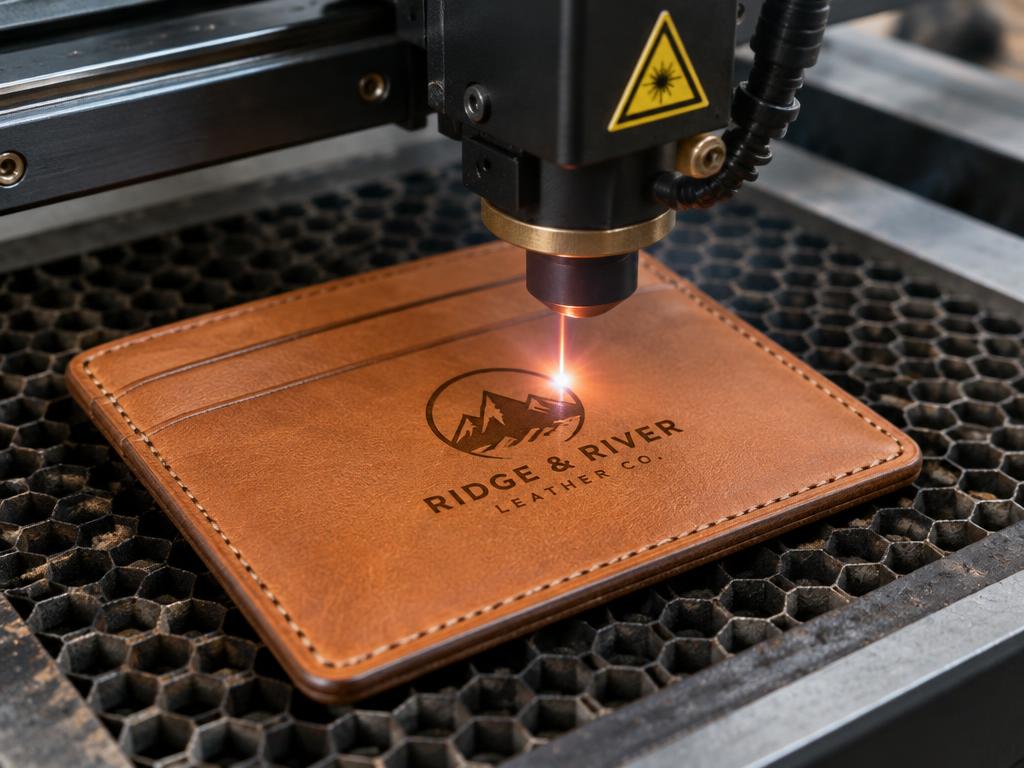
On leather menu covers & folders the methods that actually work are blind deboss, hot-foil stamping, laser engraving, metal logo plate, marked hardware, woven or printed label, screen or pad print and printed lining or inside stamp. The mark normally sits on the front cover, centred or bottom-right. A deboss is the most durable because the mark is the leather itself; a metal plate carries the most perceived value and the most tooling; laser needs no die and is the only practical route for per-piece personalisation.
Key takeaways
- The position comes first: on leather menu covers & folders the pattern decides where a mark can go, and that is the front cover, centred or bottom-right.
- A deboss and a foil share one brass die, so a blind mark and a gold mark cost one piece of tooling.
- Foil, print and plates sit on the surface; a deboss and a laser mark are in the material. Match the method to where it will rub.
- Vector artwork with fonts outlined, at final size, minimum line weight about 0.5 mm — or the die cannot be cut.
- Nothing is branded in bulk until you approve a strike-off on your actual article and colour.
- Tooling is one-time and kept on record, so repeat orders start at cutting.
Blind deboss and hot foil: two marks, one brass die
Between them these two cover most of the branding we apply. They share a die, a press and an operator, and the whole decision between them is whether you need contrast on a dark article or longevity on a handled one.
What a deboss needs from the leather
A deboss is a compression of the leather, so the substance has to be there to compress. On leather menu covers & folders we typically work at 1.0–1.4 mm face leather or PU over 2–3 mm board; heavier only where an edge is handled constantly. Vegetable-tanned, full-grain and milled articles from roughly 1.2 mm up hold the crispest impression; soft, loose, heavily grained and very thin leathers take it faintly at best.
Artwork needs a minimum line weight of roughly 0.5 mm at final size. Hairlines and small reversed-out text fill in, because the leather closes around the die rather than holding a knife edge.
When foil earns its place
Foil is the only way to get a legible mark at a distance on a dark or black article, and that is most of what it is for. It is a film sitting on the surface, so it abrades where the product is handled, rubbed or folded.
On leather menu covers & folders the rule is simple: use foil where you need contrast and the surface is protected, and use a blind deboss anywhere a thumb, a strap or a buckle passes over the mark.
Laser engraving, metal plates and marked hardware
These three are where most of the interesting decisions sit, because they behave completely differently on tooling, on minimums and on how expensive the finished product looks.
Laser engraving — no tooling, variable data
A laser needs no die at all, so artwork goes straight to the machine and every piece can carry a different name, initial, number or date at no extra tooling cost. That is why corporate gifting and personalisation programmes run on it.
The trade-off is predictability. Tone is controllable on vegetable-tanned leather and on PU, and uneven on heavily pigmented, oily or waxy articles, where it can burn pale or scorch. We always strike off first.
Metal logo plate — the most perceived value, the most tooling
An etched or die-struck brass or zinc plate carries more perceived value than any other method. It also needs its own etch or mould tooling, which means a longer first lead time and a real minimum.
Fix the fixing on the tech pack: riveted from behind, screwed, or stitched through a reinforcement. A plate that is only glued will lift at a corner, and no amount of logo quality survives that.
Marked hardware — your logo on the metal
The hardware we normally specify on leather menu covers & folders is screw posts, Chicago screws, corner pockets, elastic cords, rings and engraved metal plates in brass, nickel or matt black. Laser-marking or etching those stock parts is the low-minimum route and is available on almost any order.
Casting your own hardware from a custom mould gives a far better result and carries mould tooling, a much higher minimum and a longer first lead time. It is worth it on a long-running range and rarely on a first order.
Labels, linings and packaging — the marks buyers forget
The lining on leather menu covers & folders is typically suede, bonded leather, felt or wipe-clean coated lining, with board stiffener for rigidity. That is a branding surface, and it is the cheapest one you own because it consumes no face leather and no exterior real estate.
Packing is normally tissue and poly bag, then a printed gift box, kraft sleeve or dust bag; swing tags, barcodes and gift-message cards on request. A branded box, sleeve, dust bag, tissue, swing tag and care card can all be made to your brand guidelines and are quoted alongside the product.
- Woven damask or satin labels, printed satin, or a sew-on leather patch — stitched in rather than heat-sealed wherever the product allows.
- Composition, care and origin wording, which several markets expect and which a label can carry at the same time as your name.
- A printed or jacquard lining from moderate quantities upward, or a small inside stamp at any quantity.
- Swing tags and care cards, which carry a barcode and retail price as well as the logo.
- Outer packaging — box, sleeve, dust bag, tissue — bearing in mind print has its own minimum and lead time, usually longer than the leather.
Why the label is usually two jobs, not one
Buyers for leather menu covers & folders are typically hotels, restaurant groups and hospitality suppliers, and for all three the sewn-in label has to carry composition, care and country-of-origin wording as well as the brand name. Specifying it as a branding item and then discovering it also has to be a compliance item is how a shipment gets held at a label, which is an expensive way to learn the difference.
Get the wording confirmed at sample approval. Label mills carry their own minimums and their own lead times, and on a first order the label is more likely to be the critical path than the leather is.
How genuine leather and PU take the same mark differently
Most leather menu covers & folders we make are genuine leather, but the same programme often runs a PU version at a lower price point, and the branding does not transfer between them. Leather is a natural, variable, absorbent substrate; PU is a consistent coated one. The same artwork needs different settings, and sometimes a different method.
- Deboss on full-grain or vegetable-tanned leather: the deepest, crispest mark available, and it darkens attractively with the leather around it.
- Deboss on PU: repeatable and clean, but shallower. A deep strike can craze the coating at the edge of the impression, so an embossed-grain PU holds it better than a smooth one.
- Foil on leather: good contrast, slight variation hide to hide. Foil on PU: very even, and the usual choice on dark PU.
- Laser on vegetable-tanned leather and on PU: controllable. Laser on heavily pigmented, oily or waxy leather: unpredictable, and the reason we strike off.
- Screen and pad print: well behaved on PU and pigmented leather, riskier on soft or stretchy articles where ink can crack at a fold.
- A die setting proven on one material is never carried across to the other. Each article gets its own strike-off.
What your artwork has to be before we can cut a die
Almost every branding delay we see is a logo that arrived as a JPEG the week production was due to start. Send the artwork on day one and branding runs in parallel with sampling, costing you nothing in lead time.
We will measure the thinnest line in your file and tell you whether it holds at the size you want. A monogram usually needs about 8–10 mm of width to stay legible on leather and a wordmark considerably more; on leather menu covers & folders the available area often decides the size before taste does.
- Vector artwork — AI, EPS, PDF or SVG — with fonts outlined, so nothing reflows on our machines.
- Single colour for a deboss or a foil; one file per colour for a print.
- Supplied at the final size you want it struck, not scaled to fit a page.
- A foil colour reference, or confirmation that the mark is a blind deboss.
- Confirmation that you hold or are licensed to use the artwork — we do not carry out trademark clearance.
- Which surfaces the mark goes on: leather, lining, hardware, tag or packaging.
The size is set by the pattern, not by your brand guidelines
We will also tell you the largest size that works, and on leather menu covers & folders that is decided by the pattern rather than by taste. The mark sits on the front cover, centred or bottom-right, and the usable area there is fixed by the construction — so the brand guideline that says the logo is never reproduced below a certain width sometimes has to lose that argument.
If it does, the usual answer is a simplified lock-up: the symbol alone, or the wordmark alone, cut as a second die at the smaller size. That is a design decision worth making deliberately rather than discovering on a strike-off card.
Strike-offs: why you approve a physical mark, not a mock-up
A digital mock-up shows you a logo on a photograph of leather. A strike-off shows you the logo in the leather, at two or three settings, on the colour you are actually buying — and the gap between those two things is where most branding disappointment lives.
You pick the strike you want and we record the settings — die, size, position, pressure and temperature — against your logo, so the result is repeatable on a reorder two years later. Laser skips the tooling step and goes straight to a strike-off.
On leather menu covers & folders we strike off on the actual panel in the position you have specified rather than on an offcut, because on a leather menu cover the surrounding construction changes how the mark sits — what is behind the leather at the moment of the strike decides how deep and how even the impression is.
Expect close, not identical. No two hides take heat, pressure or laser energy in exactly the same way, and vegetable-tanned and pull-up articles vary most. The strike-off sets the standard; what varies is tone and depth inside the range it showed you.
Tooling, repeat orders and what actually drives the cost
A brass die is engraved for one mark at one size and kept on record with its settings, so repeat orders — and other products in your range carrying the mark at that size — need no new tooling. A size change or a logo redesign means a new die. Die cost is one-time and quoted with the first order.
Branding follows the product MOQ rather than carrying one of its own: 50 pieces per design for leather menu covers & folders. The exception is where the branding is the product — leather patches start at 500 pieces, and woven labels carry the label mill's minimum rather than ours.
- Number of methods on the piece — each one is a separate operation and a separate in-line check.
- Number of surfaces — leather, lining, hardware, tag and box are five set-ups, not one.
- Number of distinct marks and sizes, because each size is its own die.
- Per-piece personalisation, which adds handling time rather than production time and has a practical ceiling per run.
- Whether the mark can be applied to a flat panel before assembly, which is faster and cleaner than branding a finished article.
- Packaging print, which usually has a higher minimum and a longer lead time than anything we do in leather.
Ready to start your order?
Send your brief and get a quotation and sampling plan within one working day.