Materials
Genuine Leather vs PU for Leather Briefcases: Which Should Your Brand Choose?
By the India Leather Manufacturer production teamUpdated 18 min read
Quick answer
Choose genuine leather for leather briefcases when longevity, patina and premium positioning matter, and when you want a deep blind deboss; choose a microfibre or coated PU when colour range, batch consistency, weight and price matter more, or when the range is vegan-positioned. The decisive detail on this product is the top handle roots: leather wears there gradually, while an economy PU can delaminate at that point. Many brands run the same pattern in both as a good-better range.
Key takeaways
- Specify the article, not the adjective — PU face thickness, backing type and grain matter as much as a leather article and substance.
- Leather fails gradually and visibly; PU fails suddenly at a flex point, and the backing grade is what decides when.
- Deboss belongs to leather, foil belongs to a smooth PU face, and laser needs a trial on either.
- Leather shade varies lot to lot; PU is consistent within an article but the article itself can be discontinued.
- Most vegan leather is PU — make only the claim you can evidence with a supplier declaration.
- One pattern can run in both materials, which is the cheapest way to hold two price points.
What the two materials actually are
Most material arguments are really vocabulary arguments. Before deciding anything for leather briefcases, it is worth being precise about what is on the table, because the words used in trade — genuine leather, real leather, vegan leather, PU — cover a very wide range of quite different products.
It is also a decision that gets made style by style rather than once for a whole range. A doctor bag and the rest of the line — attaché, laptop briefcase, document portfolio, doctor bag — do not all want the same material, and the brands that handle this well choose per style against a price point instead of declaring a house material and living with it.
Genuine leather, by grade
Full-grain keeps the hide's outermost surface intact, marks and all, and is the grade that develops a patina. Top-grain has had that surface lightly corrected and sanded, which makes it more uniform and slightly less durable. Corrected-grain has been sanded further and given an embossed grain, so it is consistent and cheaper but has lost most of the natural character. Split leather comes from the lower layers and is a different material in behaviour, whatever it is called on a label.
Tannage matters as much as grade. Vegetable-tanned leather is firmer, darkens with light and holds a deep crisp deboss, which is why heritage ranges use it. Chrome-tanned leather is softer, more colour-stable and more water-tolerant, and takes a wider colour range. For leather briefcases we normally work with: full-grain and top-grain cow or buffalo, nubuck and suede; milled and pull-up finishes where you want a softer body; PU and vegan options for price-led ranges.
PU and coated materials, by construction
A PU material is a polyurethane face layer on a backing — woven or non-woven — and both halves matter. The face determines grain, hand and abrasion resistance; the backing determines tear strength and how the material behaves when it is folded or stitched. Microfibre PU, where the backing is a non-woven microfibre structure rather than a simple cloth, is a genuinely different product from an economy PU on a thin knit, and it is the grade worth specifying for anything in daily use.
This is why a quotation against the word PU is not comparable with anything. Ask for the article, the face thickness, the backing type and the grain, in the same way you would ask for a leather article and substance.
Substance and hand on a leather briefcase
The right material for a product is partly a question of what substance the construction needs, and whether the material behaves well at that substance. On leather briefcases the normal range is 1.4–2.0 mm (3.5–5 oz) for body panels and 2.0–3.0 mm (5–7.5 oz) for straps, handles and base reinforcement.
At that substance, genuine leather gives a firm hand that holds a fold and relaxes into shape with use. PU at a comparable thickness is more uniform, lighter, and does not relax in the same way — which is sometimes exactly what you want and sometimes the thing that makes a piece feel cheap. The deciding factor is usually the construction: clicker-cut panels, skived seams, strap anchors reinforced with rivets or webbing tape, optional base board and metal feet.
On this product the lining is part of the material decision rather than a detail underneath it, because it is doing structural work as well as protective work: cotton twill, canvas, poly twill or suede; printed or jacquard lining with your artwork from moderate quantities upward.
How the material choice changes the rest of the spec
On a bag the material decision and the structure decision are the same decision. A firm hide can carry the silhouette on its own; a PU body gets the same look from interlining and a board base. Brief them together — a PU bag patterned as though it were leather arrives soft, and that is almost always read as a quality fault rather than a design choice.
Zips (YKK or equivalent), D-rings, swivel snaps, rivets, base feet, magnetic snaps and turn-locks in antique brass, nickel, gunmetal or a plating matched to your reference. Hardware is worth settling alongside the material rather than after it. A plating that reads warm and expensive against a tan full-grain can look cheap against a flat black PU, and the reverse is just as true, so we normally show the hardware on both materials at sampling when a brand is running a good-better range.
Turned edge on lined panels, edge paint on straps and handles, burnished raw edge where the leather is vegetable-tanned. Edge treatment is the clearest technical difference between the two materials on this product. A painted or burnished edge belongs to genuine leather; on PU a turned edge or a heat-sealed cut edge is normally the correct build. Asking for painted edges on PU is one of the more common ways a specification quietly becomes unmanufacturable.
- Frame & gusset — A board-and-frame build gives the hard-edged attaché shape; a soft gusset gives a lighter, more flexible case. The two are different patterns, not a finish option.
- Document & laptop sizing — Built around A4 or Letter plus the machine size you list, with the internal divider layout set on the tech pack.
- Handle & lock — Top handle roots and the lock plate are the two parts that take the abuse; both are reinforced and load-checked on the sample.
Specification rows that move with the material
Those are the rows we most often have to revisit when a brand switches material part-way through a project. None of them is a finishing decision — each is a pattern or a tooling decision — so changing material after sample approval usually means a second sample rather than a substitution.
Genuine leather and PU compared for leather briefcases
Direction only — we do not publish figures, because the spread within each material is wider than the gap between them. A premium microfibre PU can cost more than a modest split leather, and both can be the right answer.
| Consideration | Genuine leather | PU and coated materials |
|---|---|---|
| Hand and appearance | Natural grain with visible variation; develops patina and darkens at wear points | Uniform surface in any grain you specify, including grains that do not exist in nature; stays as it started |
| Durability on this product | Longest service life when the substance is right, and wear reads as character rather than outright failure. Put the specification effort into the top handle roots. | Good in microfibre grades, shorter in economy grades, where the face can delaminate from the backing at the flex points |
| Structure and drape | Holds a shape at the right substance and softens into a used shape over a season | Needs interlining and board to do the same job, which is how a light PU bag still reads as substantial |
| Load-bearing parts | Straps and handles are cut heavier from the same hide and carry the load directly | Straps are reinforced with webbing or a leather core, because the backing is the limit rather than the face |
| Cost direction | Higher, and more variable — driven as much by yield as by the hide price | Lower and far more predictable, because a roll has no defects to cut around |
| Colour range | Wide, but constrained by what the tannery runs; deep blacks and browns are easiest | Effectively unlimited, including metallics, pastels and two-tone effects |
| Batch consistency | Shade varies hide to hide and lot to lot; matching across a set or a repeat takes active management | Consistent within a roll and across rolls of the same article, which is why it suits large uniform programmes |
| Blind deboss | Excellent, especially on vegetable-tanned leather, which takes a deep crisp impression that darkens at the edges | Shallow and softer; a heavily finished PU can resist a die and the impression can relax over time |
| Hot foil | Good; coverage and crispness depend on the tannage and the finish, so it is always trialled first | Very good — a smooth uniform face is the easiest surface foil can land on |
| Laser engraving | Excellent for fine detail and small type, and the method we use for per-piece names and serial numbers | Possible but handled with care, since a laser can scorch or melt a polyurethane face; a trial is essential |
| Care in use | Wipe, condition occasionally, keep out of prolonged wet; scratches can often be worked out | Wipe clean with a damp cloth; no conditioning needed and none effective; damage to the face is permanent |
| Typical positioning | Premium and heritage ranges, and anything sold on longevity — doctor bag designs for executive gifting firms sit here naturally | Fashion, promotional, uniform and vegan-positioned ranges, and anywhere colour count matters more than lifespan |
Where leather briefcases wear out — and how each material fails there
A material decision is really a decision about one or two specific places on the product. These are the parts that fail on this one:
- The top handle roots, which lift a loaded case many times a day
- The lock plate and its surrounding leather, where a twist or push lock is operated constantly
- Corners, which on a structured case cannot forgive a knock the way a soft bag can
How genuine leather fails
Leather fails slowly and visibly. The finish wears through at the points of highest contact, the fibre structure stretches at a slot or an anchor, and a fold cracks if the panel was never skived thin enough. Almost all of it is gradual, which is why a leather piece is usually retired rather than broken — and why the substance and the skiving in the specification matter more than the hide price.
How PU fails
PU fails suddenly and at a point. The face layer separates from its backing at a flex line, or abrades through at a corner, and once it has started there is no repair and no patina — the product simply looks damaged. Economy grades on thin knit backings do this in months at a fold; microfibre grades on a proper non-woven backing can last years. This is the single most important distinction in the PU decision, and it is invisible in a photograph.
What we do about it either way
Strap & handle load check: handles and straps are loaded on sampled pieces to confirm anchors, rivets and bar tacks hold without the leather tearing or the stitching drawing. Zip cycling: sliders are run the full length of the tape repeatedly and checked for catching at the corners, where a badly set zip almost always shows first. Hardware finish & rub: plated hardware is rubbed and checked against the approved sample for colour and gloss so one lot does not arrive a different shade of brass. Those checks are run whichever material you choose, because the failure modes differ but the stress points do not.
How each material takes your branding
Branding behaviour is often the deciding factor, and it is the one buyers test last. On leather briefcases the mark normally sits on the front panel, a strap keeper or the inside pocket, and the method should be chosen for the material rather than the other way round.
A blind deboss on vegetable-tanned leather is the best-looking mark available in this trade: the die compresses and darkens the leather, and the result deepens with handling. The same die on a heavily finished chrome-tanned article gives a shallower impression, and on a PU face it can relax back within weeks. Hot foil is the opposite — it loves the smooth uniform surface of a PU or a finished leather, and is harder to land cleanly on an open-pored full-grain. Laser holds the finest detail on leather and needs careful power settings on PU, where too much heat scorches or melts the face.
Whichever way you go, ask for the branding trial on your actual material at the size you intend to sell. It is the cheapest correction available and it is almost never done early enough.
Colour, consistency and the repeat-order problem
Two to four colours per style is comfortable at MOQ; hardware plating is usually kept common across colours to keep tooling simple.
The repeat order is where the two materials diverge most sharply, and it is the part of the decision that catches brands out. A leather shade is matched to a reference, not reproduced exactly: hides vary, lots vary, and a repeat order six months later lands close rather than identical. That is normal, it is managed by matching to a retained physical reference rather than to a screen, and on a full-grain article a degree of variation is part of what you are selling.
PU has the opposite profile. Within an article it is extremely consistent, which is why uniform and corporate programmes live there — but the articles themselves get discontinued by mills without notice, and the replacement is never quite the same grain or hand. For a repeat programme we reserve material against your forecast rather than re-sourcing mid-season. Brands that skip that step find out on the second order, not the first.
Care, and what to tell your customer
Care instructions are part of the product, and getting them wrong generates returns that have nothing to do with manufacturing quality. The two materials need opposite advice, so the care card has to follow the material rather than the brand template.
- Genuine leather: wipe with a dry or barely damp cloth; condition occasionally and sparingly; dry naturally away from direct heat if it gets wet; expect darkening and patina at contact points
- Genuine leather: do not use household cleaners, solvents or alcohol wipes, which strip the finish and leave a permanent pale patch
- PU and coated materials: wipe clean with a damp cloth and a mild detergent; nothing needs conditioning and conditioners do not help
- PU and coated materials: avoid prolonged heat and direct sun, which embrittles the face layer and accelerates delamination at folds
- Both: store with the piece stuffed or supported rather than folded flat under weight, and out of a sealed plastic bag
- Both: on leather briefcases specifically, the parts worth mentioning on the care card are the top handle roots and the lock plate and its surrounding leather
- Store the bag empty and supported rather than folded flat, so the base and the gusset keep their shape
- Wipe the base and the feet, not only the body — that is where floor dirt sits and where abrasion starts
Vegan, recycled and bio-based options
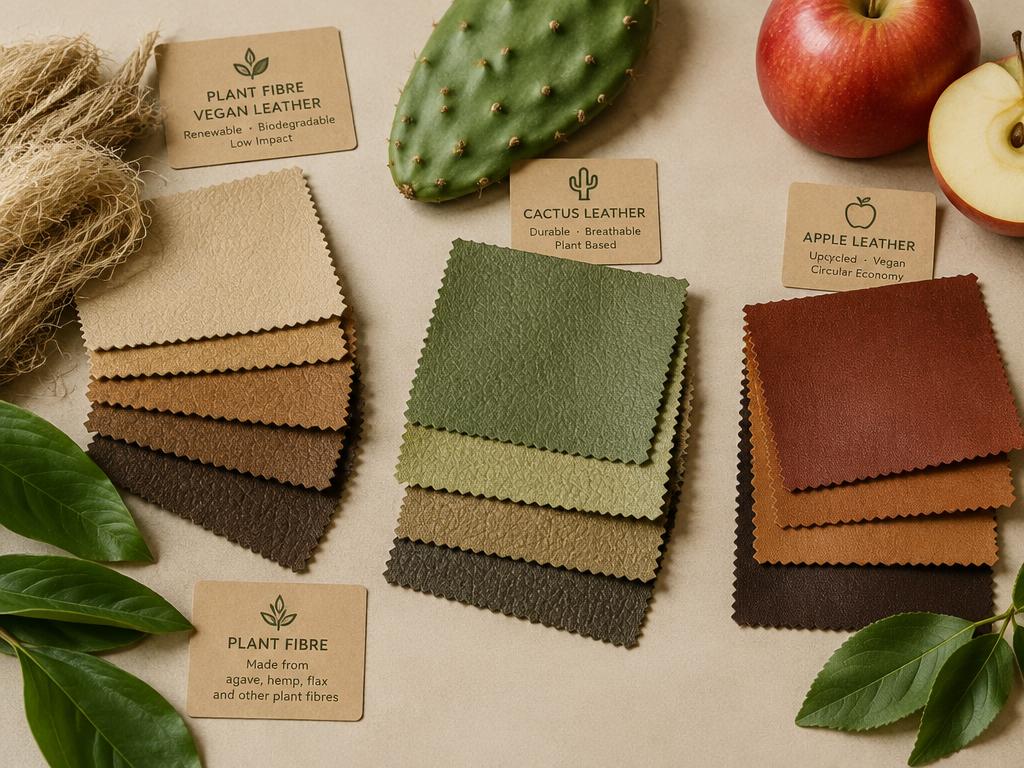
Most material described as vegan leather is PU, and the honest version of that claim is simply that it is animal-free. Beyond standard PU there are recycled-backed materials, where the textile backing uses recycled content, and a growing set of bio-based materials that blend plant inputs — cactus, apple, grape, cork — with a polyurethane binder. They are real options with real trade-offs: hand and appearance are often good, durability varies a great deal by article, and availability and minimum quantities are less reliable than mainstream PU.
On the leather side, the equivalent asks are chrome-free or vegetable tanning, leather from tanneries with traceable sourcing, and REACH-compliant dyes and finishes. We can source to those requirements and we document what the material is, with supplier declarations and material statements on request, so your own marketing claims are supported by something.
Which material for which market position
There is no universally correct answer, only an answer that matches a price point and a promise. These are the four positions we see most often on leather briefcases.
Premium and heritage: full-grain, often vegetable-tanned
If the product is sold on longevity and the customer expects it to age, this is the only honest choice. Expect shade variation between pieces, specify the substance properly, and lean into the deboss — a deep blind mark on vegetable-tanned leather is the clearest signal of this position there is. doctor bag designs for executive gifting firms typically sit here.
Mid-market retail: top-grain, with structure doing the work
The commercial middle of this category. A good top-grain article with a well-specified interior and consistent hardware reads as a quality product at a reachable price, and it repeats reliably because the article is a stock one. This is where most private-label programmes land, and where the interior specification earns more than a hide upgrade would. On leather briefcases the interior in question is: cotton twill, canvas, poly twill or suede; printed or jacquard lining with your artwork from moderate quantities upward.
Volume, promotional and uniform: microfibre or coated PU
When colour count, consistency and price are the requirement — gifting, promotions, uniform programmes, supermarket and marketplace ranges — PU is the right material and not a compromise. Specify a microfibre grade if the piece gets daily use, reserve the article against your forecast, and accept that the product will be replaced rather than conditioned.
Vegan-positioned retail: specify the article, not the adjective
If animal-free is the selling point, the material becomes part of your brand story and will be scrutinised. Choose a named article you can describe, get the declarations, and resist the temptation to imply more than the material delivers. A clearly described recycled-backed PU is a stronger position than a vaguely described bio-based blend.
Or run both, from one pattern
The same pattern can be produced in genuine leather and in PU, and running both is the most common structure we see — genuine leather for the core line, PU for seasonal, promotional or vegan ranges. It shares the pattern work, keeps the silhouette consistent across the range, and lets you hold two price points without designing twice. The hardware and the interior usually need adjusting between the two, so sample both rather than assuming one translates.
Ready to start your order?
Send your brief and get a quotation and sampling plan within one working day.