Pricing & MOQ
Leather Menu Covers & Folders Manufacturing Cost & MOQ: What Brands Should Budget
By the India Leather Manufacturer production teamUpdated 14 min read
Quick answer
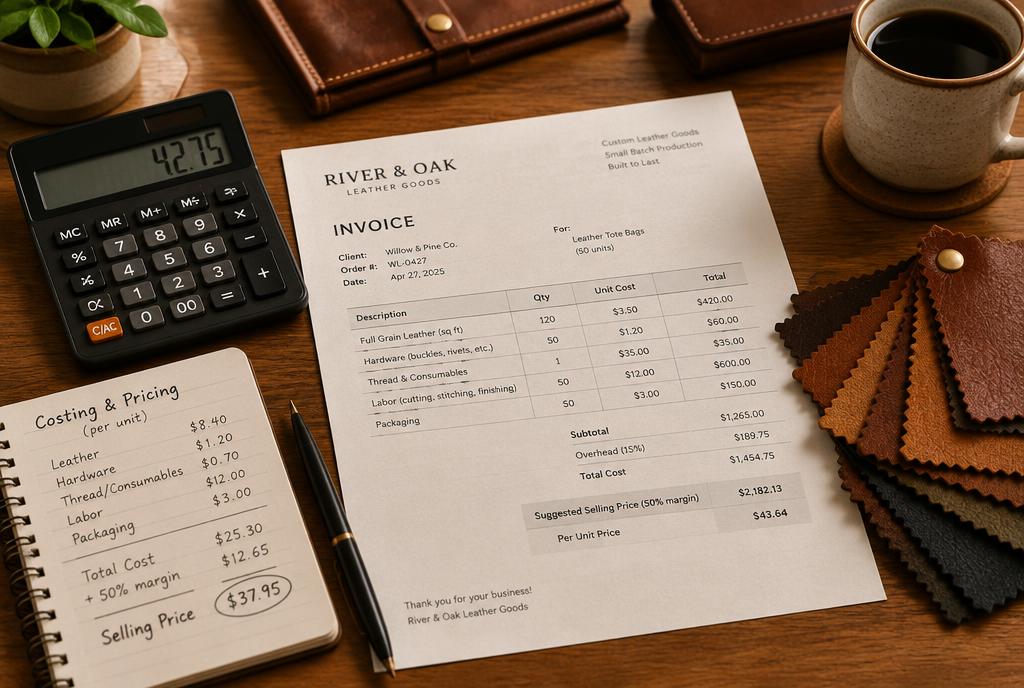
The cost of custom leather menu covers & folders is driven by material grade and yield, the number of operations, hardware and plating, the lining and interior build, the branding method, the packaging and the quantity per colour. Flat panels wrapped over board, which nest well — but each cover needs turn-in allowance all round and a mitred corner at each of four corners, and that hand work is the real content of the quotation.. Minimums in India typically start from around 50 pieces per design, applied per design rather than per order. The fastest ways to reduce unit cost are depth on fewer colours, stock material and hardware, and removing operations rather than downgrading the leather.
Key takeaways
- Material yield, not surface area, drives the material cost on this product.
- Cost follows operations: every pocket, zip, coat of edge paint and bar tack repeats on every piece.
- The minimum of around 50 pieces applies per design, because patterns and dies are per design — colours usually pool, styles never do.
- Per-piece work such as personalisation does not get cheaper with volume the way tooling does.
- Ask for a costed specification, not a single number — a quotation without material, substance and packaging is not comparable.
What moves the unit cost up, and what brings it down
Use this as a worksheet. Nearly every line is a decision you control, and the right-hand column is where most of the saving on a first order actually comes from.
| Cost driver | Moves it up | Brings it down |
|---|---|---|
| Leather grade and tannage | Full-grain from a top tannery, vegetable tanning, a speciality finish, a custom-tanned colour | A stock article from our range in a stock colour, with the shade variation accepted rather than fought |
| Hide yield and turn-in allowance | Large flat wrapped panels, where every edge needs an allowance that never shows | Smaller formats, or a cut-edge build instead of a fully turned and wrapped one |
| Typical substance | Heavier leather than the design needs — on this product the normal range is 1.0–1.4 mm face leather or PU over 2–3 mm board; heavier only where an edge is handled constantly | Specifying the substance the construction actually requires, and skiving rather than thinning the whole panel |
| Kitting and presentation | Rigid gift box with a die-cut insert, per-recipient names, individually labelled cartons | A single item in a kraft sleeve, bulk packed |
| Operations count | Extra pockets, extra zips, additional edge-paint coats, decorative stitching, contrast panels | Consolidating features, reusing one proven interior across several outer styles |
| Hardware and plating | Cast logo plates, custom-shaped parts, non-standard plating, branded zip pulls and dyed tape | Stock hardware in one plating shared across every style in the range |
| Branding | Per-piece names or serial numbers, several foil hits, metal plates set by hand | One blind deboss or laser mark from a single die, placed in the marked branding area |
| Packaging | Rigid printed gift box, die-cut insert, dust bag, swing tags, barcode labels, retail-ready packs | Poly bag and export carton, with retail packaging added once the product has proven itself |
| Quantity per colour | A small total split across many colours and sizes, so every combination is tiny | Depth on fewer options — 200 pieces in one colour cuts and books material far better than the same quantity split eight ways |
Material yield: why surface area is not cost
Flat panels wrapped over board, which nest well — but each cover needs turn-in allowance all round and a mitred corner at each of four corners, and that hand work is the real content of the quotation.
A cheaper leather helps a little, but on a board-and-wrap product the turn-in allowance, the corner work and the branding operations are where the hours go. Simplifying the build or the finish usually saves more than changing the hide.
Typical substance for this product is 1.0–1.4 mm face leather or PU over 2–3 mm board; heavier only where an edge is handled constantly, and specifying heavier than the construction needs is one of the quietest ways to add cost. Turned edge on covers, edge paint on cut edges, burnished edge on vegetable-tanned pieces.
What changes as the quantity goes up
Quantity does not just move the unit price; it changes what is practical. This is roughly how a programme for leather menu covers & folders evolves, and it is worth planning two tiers ahead so you are not re-tooling at every step.
| Quantity band | Tooling, colours and branding | Lead time and logistics |
|---|---|---|
| Sample, 1–3 pieces | Patterns cut from your sketch, drawing or sample; one material, one branding method so you can judge it | 7–12 days, air courier, with a sample QC report and photographs |
| Pilot, around 50 pieces per design | Patterns kept on file; one or two colours; deboss, foil or laser; real packaging so artwork is proven | 30–40 days after approval; air freight or part-container; final AQL 2.5 with a photo report |
| Standard order, roughly 250–500 pieces | Graded pattern set and approved reference sample retained; two to four colours; metal plates, woven labels, branded zip pulls become practical | 30–45 days after approval; LCL or FCL sea freight on FOB, CIF or DDP; in-line checks plus final AQL |
| Volume programme, 1,000 pieces and up | Dedicated pattern, die and hardware set kept ready; four or more colours; custom hardware and tooling-based branding worth doing | Scheduled monthly releases of 30–45 days each; FCL on a release schedule you set; your own or a nominated inspector welcome |
Decisions that are cheap now and expensive later
The expensive mistakes in this product are almost never the material choice. They are the things that were left vague and then fixed after the pattern was approved.
- Insert size & fixing — Built around your printed insert — A4, A5, DL or a custom size. Fixing can be screw posts, elastic cord, corner pockets or clear sleeves.
- Rigidity & handling — Menus get handled hundreds of times a week. Board weight and a turned, stitched edge are what keep the cover from going soft at the corners.
- Wipe-clean finish — For food service we normally spec a coated or PU face that takes a damp cloth, with genuine leather on the spine or a trim panel if you want the feel.
- Branding size and position, which is a pattern decision rather than a finishing one
- Packaging and labelling, because barcode and carton requirements change the box, not just the print
- The colour split, which determines the cutting plan and the material booking for the whole order
How to brief for a quotation you can actually compare
Most of the variance between three quotations for the same product is variance in what was understood, not in what was charged. Send all three suppliers the same brief and the comparison becomes real.
- Name the style from restaurant menu cover, hotel room folder, bill folder, wine list cover and send a sketch, a reference photograph with dimensions, or a physical piece
- State the material by article and finish, not as leather — and if you do not know, ask for two or three options with swatch cards
- Give the substance you want, or state the use and let us recommend one against the normal range of 1.0–1.4 mm face leather or PU over 2–3 mm board; heavier only where an edge is handled constantly
- The insert, refill or item that has to fit, sent physically wherever possible
- Logo artwork as a vector file, plus the finished size you want the mark at
- Whether the piece is a retail unit, a gift item or part of a kitted set
- Specify hardware and plating, and say whether one plating across the range is acceptable
- Specify the branding method, the artwork format and the finished mark size
- Specify packaging down to the swing tag and barcode, and say where the goods are going
- Give quantity per style and per colour, plus your intended repeat pattern
- Name the Incoterm and the destination port or door, so freight is quoted on the same basis
What a complete quotation contains
If any of these is missing, ask before you compare. A quotation that is only a number is not a quotation — it is a conversation starter that will be revised later, usually upwards.
- The material by article name, finish and substance, with lining and interlining stated separately
- Hardware by type and plating, and whether it is stock or tooled
- Finished dimensions and the key tolerances
- Construction detail: leather over board or foam where rigidity matters, wrapped and turned at the edges, then stitched; sets are kitted and boxed in-house
- Edge and stitch spec: turned edge on covers, edge paint on cut edges, burnished edge on vegetable-tanned pieces lockstitch at 8–10 stitches per inch; corner bar tacks on covers, and a tidy single stitch line where the branding has to be the focus
- Branding method, position and mark size, with the die or tooling cost shown separately
- Packaging spec, including carton quantity, carton dimensions and gross weight
- Unit price at several quantity breaks, sample cost and whether it is credited against bulk
- Lead times for sampling and bulk, stated from the date of approval rather than the date of order
- Incoterm, inspection standard and the payment terms
- Customs heading guidance — normally HS heading 4202 or 4205 depending on the article — confirm the exact subheading with your customs broker
Ready to start your order?
Send your brief and get a quotation and sampling plan within one working day.