Sourcing Guides
Questions to Ask a Leather Goods Manufacturer Before Ordering
By the India Leather Manufacturer production teamUpdated 13 min read
Quick answer
Ask about the company first (do they manufacture or trade?), then capability, materials, sampling, quality and inspection, capacity and lead time, branding and packaging, commercial terms and shipping, and finally confidentiality. Send the questions in writing, compare how suppliers answer rather than what they charge, and treat specificity — including a willingness to decline work — as the main positive signal.
Key takeaways
- Send the questions in writing. A written answer can be compared, filed and referred back to; a phone answer cannot.
- The most diagnostic question is 'what do you not make?' A supplier with no limits is describing a catalogue, not a factory.
- Verify that the company name matches across the GST registration, the Import Export Code, the quotation and the bank details.
- Ask process questions, not capability questions. 'Can you make bags?' gets a yes; 'who makes your patterns?' gets information.
- Quality answers should name an AQL, a defect classification and a sealed sample. Anything vaguer is a slogan.
- Judge a supplier on the revision round and the inspection, not on the first sample. Any factory can make one good piece.
How to use this list
Send the questions in writing to two or three suppliers at the same time, with the same brief attached, and read the answers side by side. Written answers can be compared, filed and quoted back later, and the act of answering in writing filters out suppliers who are not serious about a programme your size.
The point is not to collect the most favourable answers. It is to find the supplier whose answers are the most specific, including where they are unfavourable. A factory that tells you it cannot hold a tolerance, will not quote a construction at your price, or does not run a product family every week is giving you more useful information than one that agrees with everything.
Not all of these need answering before a first sample. Group one to four matter at enquiry stage; five to seven matter before a purchase order; eight and nine matter before money moves.
The company: are you talking to a factory?
Everything else depends on this. Both manufacturers and trading houses can serve you well, but you need to know which one you have, because a trader is subcontracting the part you care about and will be a message relay when something goes wrong.
- Do you own and operate the factory, or do you subcontract production?
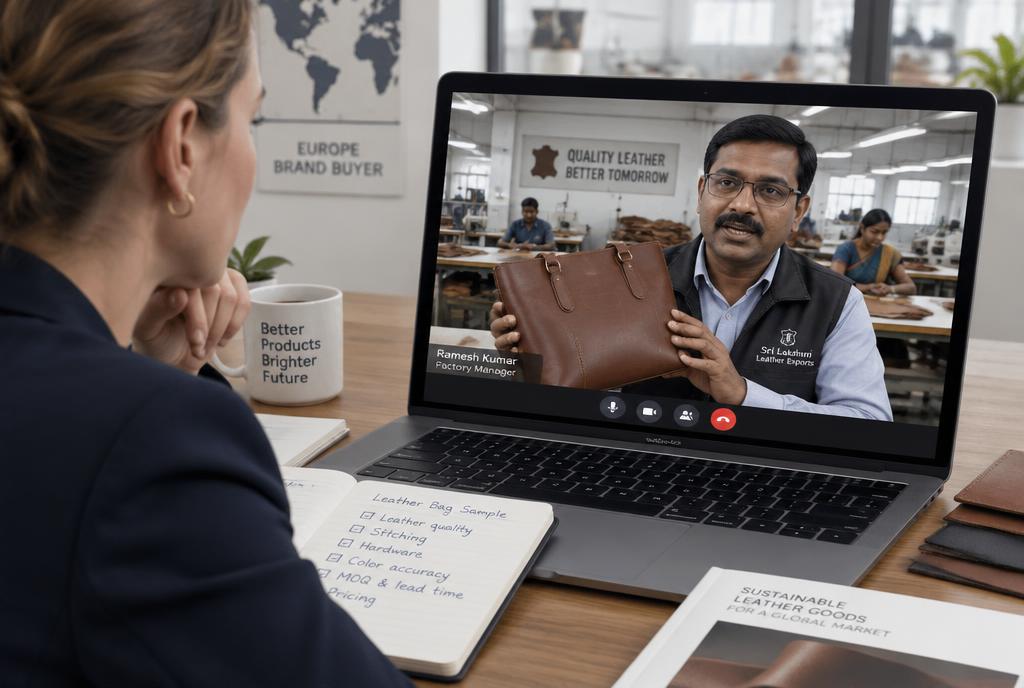
- Where is the unit, and can I see it on a live video call rather than a recorded tour?
- How long have you been manufacturing, and how long in this product category?
- Does the company name match across your tax registration, your export registration, your quotation and your bank details?
- Who makes your patterns, and where are cutting dies stored and for how long?
- Which product families do you run every week — not which can you quote?
- What do you decline to make, and why?
- Who will my day-to-day contact be, and who covers when they are away?
Capability: can they make your product specifically?
Generic capability questions get generic answers. Ask about the construction your product actually needs.
- Which machines do you have — flatbed, post-bed, cylinder arm? A factory with only flatbeds will struggle at a gusset
- Can you show me a current product in the same construction and material as mine, not a portfolio photograph?
- Do you cut on a clicker press, and do you hand-click show panels on full-grain hides?
- What edge finishes do you run in-house: turned, edge paint, burnished?
- What stitch pitch range do you work at, and how do you specify and control it?
- How do you reinforce strap anchors, handle roots and base corners?
- Can you do foam-cored construction and fitted cavities if my product needs them?
- What tolerance will you commit to on my critical dimensions?
Materials
Pay particular attention to the lot-booking answer. A supplier who books the leather for a whole run up front is managing the risk that actually destroys orders; one who buys per batch as production proceeds is leaving a visible shade step waiting to happen in the middle of your run.
- Which leather articles do you hold in stock, and can I see the swatch library?
- What substance range do you work in for my product type, in millimetres?
- Do you work in vegetable-tanned, chrome-tanned and chrome-free articles?
- Do you offer PU, microfibre and vegan or recycled-backed materials in the same patterns?
- Do you book the leather for a whole run from one lot, and will you send a lot swatch for approval before cutting?
- What shade tolerance should I expect on the article you are proposing?
- Can you supply the species, tannery and tannage on the documentation?
- Will you arrange third-party laboratory testing on a sample drawn from my order if I nominate the lab?
Sampling and development
Sampling is the cheapest due diligence available, and the answers here tell you whether a supplier treats development as a discipline or as an expense to be minimised.
- What can you work from — a sketch, a photo, a drawing, a tech pack, a counter-sample?
- How long does a first sample take, and how long does a revision?
- What does a sample cost, and is the charge credited against a confirmed bulk order?
- How many revision rounds are included before further rounds are quoted?
- Will I receive a hard pattern and a measurement sheet to check before the sample is cut?
- Will you seal and sign two samples, one for me and one retained at the factory?
- Will you give me a buildability and costing opinion before cutting, including where my design will not work?
- What happens if my nominated leather is not available — do you substitute, and do you tell me in writing?
What a strong sampling answer sounds like
It includes a measurement sheet before the sample, a written point-by-point response to your comments, two sealed samples, and an honest statement about substitutions. A weak answer is a fast turnaround time and nothing else. The speed matters far less than the paperwork, because the paperwork is what the bulk run is judged against.
Quality and inspection
A good answer names an AQL, points at a defect classification document and a sealed sample, and welcomes a third-party inspector. A poor answer is a statement about commitment to quality. The difference is not tone; it is whether an independent person could apply the standard and reach the same verdict.
- What is your default AQL, and will you work to mine?
- Do you have a written defect classification, and can I see it?
- What in-line checks happen at cutting, stitching and finishing, and can I see a real check sheet?
- Do you run a pilot run or size set at the head of the line before volume?
- Will you send a final inspection report with photographs before dispatch?
- Do you allow third-party inspection, and will you schedule around the booking?
- What happens if a lot fails inspection — who sorts, who reworks, who pays, and what happens to the date?
- What are the specific functional checks for my product type — zip cycling, snap cycling, strap load testing, device fit?
Capacity, lead time and scheduling
These are the questions that decide whether your delivery date is a plan or a hope. Ask them before the advance, because capacity is allocated when the money clears rather than when the enquiry arrives.
- What is your monthly capacity, and how much of it is committed in my delivery window?
- What is the bulk lead time, and when does the clock start — order date, advance payment or material booking?
- Will I get a written production schedule with material booking and inspection dates on it?
- What is your MOQ per design, and can colours be mixed within a style?
- How do you handle a seasonal peak — what is your cut-off for a Q4 or festival delivery?
- What updates will I get during production, and how often?
- Can you stagger dispatch or hold a call-off, and how is that quoted?
- What happens if you are running late — when would I be told, and by whom?
Branding, labelling and packaging
Branding and labelling cause more late deliveries than production does, because artwork sits at the end of the process and at the start of nobody's to-do list. Establish early what the supplier needs and when.
- Which branding methods do you offer in-house: deboss, hot foil, laser, metal plate, marked hardware, woven label, print?
- Will you strike off on my actual leather and colour before production, and record the settings?
- What artwork format do you need, and will you tell me if my logo will not hold at the size I want?
- Is the die cost one-time, is the die kept on record, and what happens if I change the logo size?
- Can you do per-piece personalisation, and what does it add to the schedule?
- Can you print and apply my composition, care, origin and importer labels exactly as I specify?
- Can you apply barcodes I supply, and do you understand that the numbers come from my GS1 account?
- Can you pack to a written retailer, marketplace or 3PL prep specification?
Commercial terms, shipping and documents
On documents, the standard set is the commercial invoice, the packing list, the bill of lading or air waybill, and the certificate of origin. Ask separately about anything your destination adds — several Gulf and Caribbean entries want the invoice and certificate of origin chamber-stamped or legalised, which adds working days before the container sails and has to be raised at the order stage.
- What are your payment terms, and what does the advance release?
- How long is a quotation valid, and how is it re-confirmed against the hide market?
- Which Incoterms do you offer, and from which Indian gateways?
- Which port or airport will my goods actually leave from, and what is the inland leg?
- Which documents are issued as standard, and can you handle chamber attestation or legalisation if my destination needs it?
- Who is responsible for duties, clearance and insurance under the term you are quoting?
- Can you work with my nominated freight forwarder?
- What are your carton specifications — quantity, weight cap and marking?
Confidentiality and intellectual property
Keep two ideas separate here. Confidentiality is an NDA and it covers your drawings, artwork and commercial terms. Exclusivity is a commercial arrangement about whether a pattern can be sold to someone else, and it applies to patterns developed for you rather than to a factory's existing styles. Neither is the same as a registered design right in your own market, which is a legal step you take yourself.
- Will you sign an NDA before I send drawings or a tech pack?
- If you develop a pattern for me, is it exclusive to my programme, and is that stated in writing?
- Can you confirm that my designs will not be shown to other buyers or used in your own samples?
- Who owns the pattern files, and can they be transferred to me or to another factory if I ask?
- How long are patterns, dies and sealed samples retained if I do not reorder?
- Will my logo artwork be used only for my orders?
Reading the answers
The pattern across all of the above is the same: specificity is the signal. Here is what the difference looks like on the questions that matter most.
| Question | A weak answer | A strong answer |
|---|---|---|
| Do you own the factory? | 'Yes, we have a big facility' | A live video walk where you choose the direction, including the pattern room and die store |
| What is your MOQ? | 'Flexible, tell us your quantity' | A figure per design, with colours mixable, and a note on which minimum binds — material, tooling or packaging |
| What is your lead time? | '30 days' | 30–45 days from material booking, with material booking released by the advance, plus a written schedule |
| How do you control quality? | 'We are committed to the highest quality' | In-line checks at three stages, a pilot run, a named AQL, a defect classification, a photo report, and third-party inspection welcomed |
| Can you match this colour? | 'Yes, no problem' | 'From stock, close; on aniline expect a tolerance. We will send a lot swatch before cutting' |
| Can you make this design? | 'Yes, we can make anything' | A buildability note, a question about the two ambiguous details, and a cost implication for the gusset |
| Will you sign an NDA? | 'Of course, send it over' | The same, plus a clear statement of what exclusivity does and does not cover on their existing patterns |
Ready to start your order?
Send your brief and get a quotation and sampling plan within one working day.