Sourcing Guides
Why Source Leather Goods from India? A Buyer's Assessment
By the India Leather Manufacturer production teamUpdated 14 min read
Quick answer
India combines a large domestic hide and tanning base with long-established finished-goods clusters, so one supply base can cover genuine leather, PU and vegan materials. For brands, the practical advantages are low minimums per design, a deep hand-finishing skill base, English-language working and well-served sea and air gateways. The main caveats are shade consistency on natural-finish leathers and the need to verify that a supplier manufactures rather than trades.
Key takeaways
- India's advantage is vertical: hides, tanning, hardware, components and finished goods all exist inside the same supply base.
- The clusters specialise. Kanpur, Chennai, Agra, Kolkata and Delhi NCR are not interchangeable, and picking the wrong one wastes months.
- Low minimums per design — from 100 pieces, with colours mixable — are the single most useful feature for a growing brand.
- Hand operations are genuinely available at a commercial price: hand clicking around hide defects, saddle stitching, burnished edges.
- Compliance is buyer-led. A factory supplies material declarations and arranges testing on drawn samples; the importer carries the regulatory duty.
- Be honest about the limits: no exotic skins, wider shade tolerance on natural-finish articles, and verification work you have to actually do.
The raw-material position, and why it matters downstream
India has a large domestic livestock base and a long-established tanning industry, which means hides and finished leather are available domestically rather than imported. For a buyer this has one concrete consequence: the leather, the hardware, the linings and the finished goods can all be sourced inside one country, often inside one city, and a factory can hold or book stock of an article rather than waiting on an import shipment to start a run.
The practical range covers cow, buffalo and goat hides in both vegetable and chrome tannages, plus the full span of PU and coated materials and the newer vegan and recycled-backed substrates. Buffalo gives heavier, more textured leather suited to rugged bags and travel goods; cow covers most of the structured and small-goods range; goat is the choice where a soft, fine-grained panel is needed. We work in those hides plus PU and vegan materials only — no exotic or CITES-listed skins — which keeps wildlife declarations and permits out of a buyer's entry altogether.
The clusters, and what each is actually known for
Treating 'India' as one sourcing destination is the most common and most expensive mistake a new buyer makes. The clusters developed around different raw materials and different historical demand, and they still specialise.
| Cluster | State | Known for |
|---|---|---|
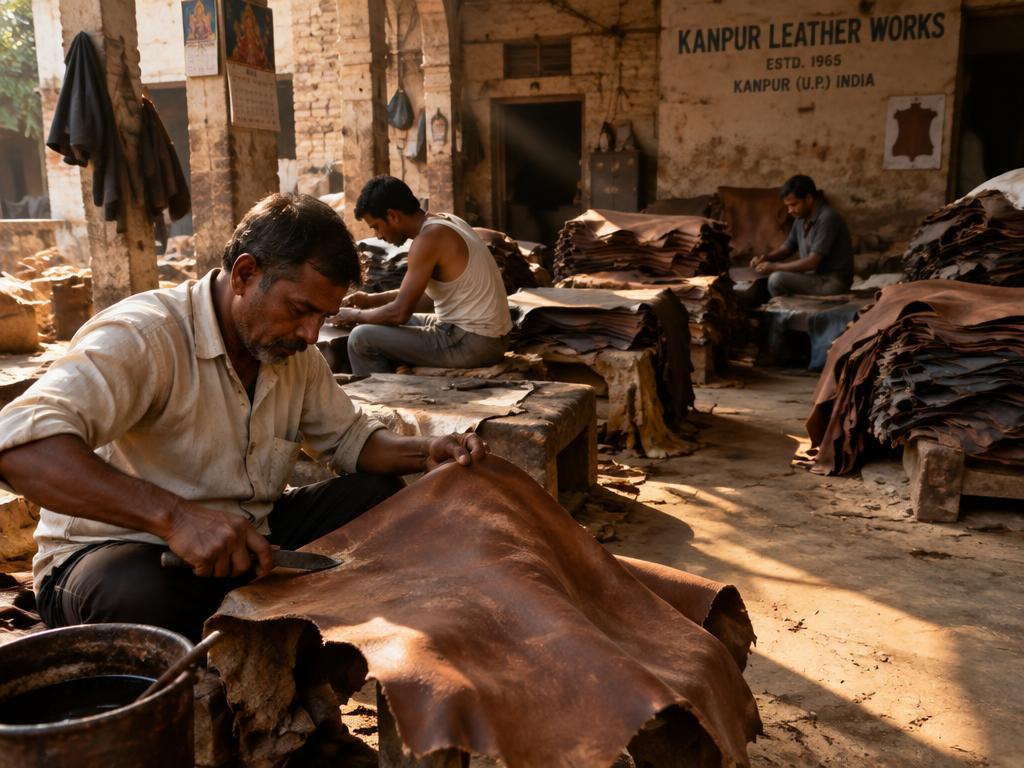
| Kanpur | Uttar Pradesh | Tanneries, heavy buffalo and cow leather, saddlery and harness, bags, belts, industrial leather |
| Chennai belt — Ambur, Vaniyambadi, Ranipet | Tamil Nadu | Finished leather and the largest footwear and footwear-component base |
| Agra | Uttar Pradesh | Footwear at very high volume, with an accessories base alongside it |
| Kolkata | West Bengal | Tanning and a strong small leather goods and accessories trade |
| Delhi NCR — Noida, Gurugram | Delhi, UP, Haryana | Fashion-led bags and accessories, close to buying offices and the air gateway |
| Jalandhar and Kolhapur | Punjab, Maharashtra | Sports goods and traditional footwear respectively, rather than fashion leather goods |
Craft skill that is still commercially available
The most under-appreciated advantage is that hand operations remain available at a price that works in a commercial product. Hand clicking — a cutter placing a die or a knife around growth marks, brand scars and vein lines so the natural marks fall where they will not be seen — is standard practice on show panels here, not an upcharge for a luxury programme. Hand saddle-stitching is available on request. Burnished edges, slicked by hand on vegetable-tanned leather, are routine rather than exotic.
This matters most on full-grain programmes, where the entire value of the grade depends on how well the cutter works around the hide's history. A factory that die-cuts blind through a full-grain hide will produce a cheaper piece and a worse one, and the difference shows up in your returns rather than in your quotation.
It also matters for development. A pattern maker who can cut a hard pattern from a sketch, prove a mock-up in cheap material and reverse-engineer a counter-sample is doing skilled manual work, and that skill base is why a first sample in 7–12 days from a drawing is a realistic timeline rather than an advertising claim.
MOQ flexibility, which is the real commercial advantage
Minimums are where India differs most usefully from the alternatives for a growing brand. Our own position is from 100 pieces per design, with colours mixable within a style, and per-product minimums that vary from lower on menu covers and folders to higher on some small leather goods where the cutting and roll economics set a practical floor. The MOQ is per design rather than per colour, which is the detail that actually helps: a brand can run two or three colourways inside one minimum and test which sells.
This changes how a range can be built. Instead of committing a large quantity to a single SKU in a single colour, a brand can place six SKUs at a low minimum each, discover which two work, and put the next order's depth behind those. For a factory, a mixed six-SKU order is often easier to schedule than one enormous single-colour run, because it fits around the line rather than monopolising it.
What a low minimum is not is free. Tooling, set-up and line changeover are spread across fewer pieces, so the per-piece price at 100 is meaningfully higher than at 1,000. The useful thing to ask for is the price at two quantities, which shows you where the curve flattens and therefore what your second order should look like.
One supply base for leather, PU and vegan materials
Most brands end up needing more than one material. A range that sells a full-grain hero bag will also want a price-led PU version for a different channel, and a buyer with a sustainability commitment will want a vegan option in the same silhouette. Having all three in one factory means one pattern, one logo die, one sealed-sample process, one inspection and one shipment.
It also means the comparison can be made honestly. We will quote the same style in two materials so the gap is visible rather than theoretical, and say plainly when a target price will not carry grain leather — in which case a good PU or microfibre is usually the better product than a thin coated split, and nobody has been misled.
The construction differences are real and worth knowing. PU cuts from a roll with consistent shade and no hide defects, so yield improves and panel matching stops being an issue. Cut edges can be heat-sealed rather than painted or turned. Branding behaves differently: a deboss has less depth to work with and laser tone shifts, so the strike-off matters more. Foam-cored construction, standard on equipment and device cases, is a PU technique rather than a leather one.
Export routes, gateways and transit
For a factory in Kanpur the normal routings are road or rail to a west-coast port, or road to an air gateway. Nhava Sheva (JNPT) at Navi Mumbai carries most sailings, with Mundra in Gujarat as the alternative west-coast service; Chennai serves east-bound Asia Pacific lanes. Delhi (DEL) is the nearest international air gateway, with Mumbai (BOM) used for consolidated air consignments and Chennai (MAA) for east-bound air.
Transit varies enormously by lane, and this is where planning goes wrong rather than where sourcing does. Gulf lanes are short — a Dubai or Muscat routing is days rather than weeks. European and North American sea lanes run into weeks, and Canadian and Mexican lanes longer again. Air freight typically runs three to seven days plus clearance. The per-country estimates on our market pages are the ones to plan from.
The method that works is to count backwards from the in-warehouse date: transit for your lane, minus two to three days for final inspection, minus the 30–45 day production run, minus 5–10 days of material booking. Then add your own review time for the sample and the artwork, which is the stage buyers consistently leave out of the plan.
Compliance: what a factory can and cannot give you
Buyers arrive with compliance expectations shaped by their own market, and the honest division of responsibility is worth stating clearly because a supplier who claims more than this is overselling.
What a factory supplies: the material declarations its tanneries and hardware suppliers provide, a statement of species, tannery and tannage for the order, permanent 'Made in India' origin marking, retail labels printed exactly to your artwork and wording, and samples drawn from your order submitted to a third-party laboratory you nominate. That test report covers the order it was drawn from — it is not a standing certification of everything made in the building.
What sits with the buyer and the importer: classification and the duty rate, the regulatory duties themselves, and who is named as the responsible economic operator on the label. Under EU and UK REACH the restricted-substance entries buyers ask about are chromium VI in finished leather and azo colourants. The EU's General Product Safety Regulation expects an economic operator established in the EU to be named on the product, which is normally you or your importer. US CPSIA brings third-party testing and tracking labels into scope only where an item is designed or marketed for children of twelve and under. California Prop 65 is usually handled by writing lead, cadmium and phthalate limits into the specification for hardware, zips and coatings. The GCC conformity scheme and the G-mark apply to listed regulated categories, and leather bags and accessories usually sit outside that list — but your clearing agent should confirm it for your heading rather than either party assuming.
Leather bags, wallets, belts and cases are not CE- or UKCA-marked product categories. If a design carries electronics — a tracker, a power bank, a lit mirror — that component brings its own regime, so flag it before sampling rather than after.
Send limits, not questions
The enquiry that gets a useful answer is 'here are the lead, cadmium, phthalate and chromium VI limits we require on the finished article' rather than 'are you compliant?'. Written limits can be quoted against, materials can be chosen to meet them, and a drawn sample can be tested to evidence them. A general compliance question can only be answered generally, which helps nobody.
Classification stays with your broker
For leather goods, HS heading 4202 covers bags, cases and wallets, 4203 covers leather apparel, belts and gloves, and 4205 covers patches, desk pieces and cut components. The full eight-digit code sits on the invoice line, but the classification and the duty rate in force on your arrival date are confirmed by your own customs broker. No factory should be classifying on your behalf, and any that offers a duty rate is guessing.
Communication, documentation and the working rhythm
English-language working is the practical advantage that buyers notice first and value most once a problem arises. A tech pack queried in writing, a measurement sheet discussed on a call, a revision list answered point by point — these happen in English without a translation layer, which removes a whole category of specification error.
The time zone is workable rather than ideal. Indian Standard Time overlaps with the European working day comfortably and with the UK for most of it; the Gulf overlaps almost entirely; North America gets an early-morning or late-evening window. The rhythm most programmes settle into is a written update cycle with photographs rather than live calls, which suits the work anyway because production questions are best answered with a picture.
On documents, the standard export set is issued as a matter of course: commercial invoice, packing list, bill of lading or air waybill and certificate of origin, plus any origin or preference documents a regime needs. For leather goods, HS heading 4202 covers bags, cases and wallets, 4203 covers leather apparel, belts and gloves, and 4205 covers patches, desk pieces and cut components; the full eight-digit code sits on the invoice line and your broker classifies the entry.
What India is not the right answer for
A sourcing guide that lists only advantages is marketing. These are the cases where the answer should be something else, and saying so saves everyone a wasted sampling round.
- Exotic or CITES-listed skins. We work in cow, buffalo and goat plus PU and vegan materials only, and buyers wanting crocodile, python or ostrich should look elsewhere
- Programmes that need an exact, repeatable shade on an aniline, pull-up or vegetable-tanned article. Natural-finish leather takes dye differently hide to hide and lot to lot; specify pigmented leather or PU where the colour has to be tight
- True one-off and very small bespoke production. A single piece is a sampling job, not a production order, and it is priced as development
- Products whose value is in integrated electronics rather than in the leather. The electronic component brings its own regime and its own supply chain
- Buyers who want a certification claim rather than a test report. A factory can arrange third-party testing on a drawn sample; standing certifications and audit memberships are a different kind of commitment and should not be assumed from a supplier's website
- Anyone who needs delivery in three weeks with no sample. An unsampled bulk order is where the expensive surprises live, wherever it is placed
A practical way to trial an Indian supplier
The low-risk sequence is the same one we would recommend to a buyer evaluating us against anyone else, and it costs days rather than seasons.
- Send one written brief to two or three suppliers: product, quantity, target landed price, material and the three features that matter. Compare how they answer, not what they charge
- Ask each for the same style quoted in two materials and at two quantities, so you can see the real drivers rather than a single number
- Buy a sample from the two strongest. Review it filled, loaded and measured, not as an impression, and send numbered comments
- Ask for a video tour and specifically ask to see the pattern room and the die store, which cannot be borrowed for an hour
- Place a first order at a low minimum across two or three SKUs rather than one large one, and appoint a third-party inspection on it
- Judge the supplier on how the revision round and the inspection were handled, not on the first sample alone — any factory can make one good piece
Ready to start your order?
Send your brief and get a quotation and sampling plan within one working day.