Import Guides
FOB vs CIF vs DDP: Incoterms for Importing Leather Goods
By the India Leather Manufacturer production teamUpdated 14 min read
Quick answer
Under EXW you take the goods at the factory and arrange everything, including Indian export clearance. Under FOB the supplier delivers them on board the vessel at the Indian port and you pay the sea freight onward. Under CIF the supplier pays freight and minimum insurance to your named destination port, though risk still passes to you at loading. Under DDP the supplier delivers to your door with import duties paid. FOB gives the most control over cost; DDP gives the least administration.
Key takeaways
- An Incoterm allocates cost, risk and clearance duties between buyer and seller. It does not set the price, the payment terms or when title passes.
- Under CIF, risk transfers to the buyer at loading in India even though the supplier is paying the freight — the two do not move together.
- CIF requires only minimum insurance cover. On a high-value leather consignment, upgrade it or insure separately.
- FOB and CIF are sea-and-inland-waterway terms. For an air shipment or a container handed over at a CFS, FCA or CIP is the correct term.
- DDP needs someone established in the destination country to act as importer of record, and it can make import VAT or GST harder to reclaim.
- Always quote the Incoterm with a named place: 'FOB Nhava Sheva', not 'FOB'. The term without the place is incomplete.
What an Incoterm settles, and what it leaves open
An Incoterm is a three-letter shorthand, published by the International Chamber of Commerce, for three specific allocations between a buyer and a seller: who arranges and pays for each leg of the carriage, who handles export and import clearance, and at what precise point risk of loss or damage transfers from one party to the other. That is all. It is extremely useful because it is standardised and because freight forwarders, carriers, banks and customs brokers all read it the same way.
It is equally important to know what it does not do. It does not set the price, although the price obviously depends on it. It does not set the payment terms, the currency or the credit period. It does not determine when legal title to the goods passes — that is a matter for the sale contract and in most jurisdictions is independent of the Incoterm. It does not override customs law: the importer of record carries the import duties and declarations whatever the three letters say.
The practical consequence is that an Incoterm belongs in a quotation alongside, not instead of, those other terms. A leather goods quotation should state the term, the named place, the payment terms and the validity period, because leather is a commodity and a price held for months is not a price anyone can honour.
The responsibility matrix: who pays what
This is the table worth printing. Read along the row for the term you are considering, and remember that every line not allocated to the supplier is a line someone on your side has to arrange.
| Term | Origin haulage and export clearance | Main carriage and insurance | Import clearance and duty |
|---|---|---|---|
| EXW (ex works) | Buyer, including Indian export formalities | Buyer arranges and pays both | Buyer |
| FOB (free on board) | Seller, up to and including loading on board at the named Indian port | Buyer arranges and pays both | Buyer |
| CIF (cost, insurance and freight) | Seller | Seller pays freight to the named destination port and minimum insurance | Buyer |
| DDP (delivered duty paid) | Seller | Seller arranges and pays everything to the named destination address | Seller, including duty and clearance |
Where risk transfers, which is not the same as who pays
This is the single most misunderstood aspect of Incoterms, and it causes real losses. Under CIF the supplier pays for the ocean freight and the insurance, but risk of loss or damage has already passed to the buyer the moment the goods are loaded on board in India. If the container goes over the side in the Arabian Sea, it is the buyer's loss and the buyer's insurance claim, even though the buyer never booked the vessel.
| Term | Risk passes to the buyer | What that means in practice |
|---|---|---|
| EXW | When the goods are placed at the buyer's disposal at the factory | The buyer's exposure starts in Kanpur, including the road leg to the port |
| FOB | When the goods are on board the vessel at the named Indian port | Damage in the port or during loading is the seller's; everything after is the buyer's |
| CIF | When the goods are on board the vessel at the named Indian port | The seller pays the freight and insurance but the buyer carries the sea risk and makes any claim |
| DDP | On arrival at the named destination address, ready for unloading | The seller carries risk the whole way, which is why DDP is priced with a contingency in it |
EXW — maximum control, maximum administration
Under EXW the goods are made available at the factory and everything after that is yours: the road leg to the port, the Indian export declaration, the terminal charges, the vessel, the insurance and the whole import side. It gives you total visibility of every cost component, which is why some large importers with established Indian operations prefer it.
For most buyers it is the wrong choice, and the reason is legal rather than commercial. Indian export formalities are performed by the exporter, and a foreign buyer is not well placed to make an export declaration in India. In practice an EXW arrangement usually ends up with the factory or its agent doing the export clearance anyway, which means you have taken on a risk you did not actually transfer. FCA — free carrier, at a named place — does the same job properly, because it puts the export clearance with the seller while still giving you the main carriage.
FOB — the default for experienced importers
FOB is the most widely used term on Indian leather exports, and for good reason. The supplier handles the inland haulage from the factory, the export documentation and the loading on board at the named port; you nominate the carrier and pay the freight from there. Because you control the main carriage, you see the real freight rate, you can consolidate with other suppliers, and you can use your own forwarder's contract rates rather than a rate marked up inside a product price.
FOB also gives you the clearest view of what your landed cost actually is, which matters because freight is volatile. A product price quoted CIF in a quiet market and a product price quoted CIF six months later are not comparable; the FOB price is.
What FOB requires from you is a competent forwarder at the destination and someone who will chase a booking. If you have neither, the theoretical saving evaporates in demurrage, missed sailings and a container sitting at a terminal accruing storage.
CIF — convenient, but understand what you have bought
Under CIF the supplier arranges and pays the ocean freight to your named destination port and takes out cargo insurance. For a buyer without a forwarder relationship it is genuinely convenient: one invoice, one counterparty, goods arriving at a port you can collect from.
Three things are worth knowing before choosing it. First, risk still passes at loading in India, as above. Second, the insurance is minimum cover unless you ask otherwise. Third, CIF covers carriage to the destination port only — terminal handling at arrival, customs clearance, duty, and the haulage from the port to your warehouse are all still yours, and first-time importers regularly budget as though CIF meant delivered.
CIF is also the term where freight margin hides most comfortably, because the freight cost is bundled into a single figure. If you use CIF, ask for the FOB price as well. The difference is the freight and insurance element, and seeing it stated is how you tell whether it is competitive.
DDP — door delivery, and the two things that go wrong
DDP means the supplier delivers to your named address with import duties and clearance done. For small consignments, for air shipments, for corporate gifting that has to reach an office rather than a port, and for buyers with no import function at all, it is the right answer and it is worth paying for. We quote it to many markets.
The first thing that goes wrong is the importer of record. Import declarations generally require an entity established in the destination country, with a registration — an EORI number in the EU or UK, an importer registration elsewhere — and a foreign seller frequently cannot be it. In practice DDP is performed through an agent or through your own entity acting as importer with the seller paying the costs. Settle who is on the declaration before the goods ship, not when they are on the quay.
The second is tax recovery. Where import VAT or GST is paid by someone other than you, reclaiming it as input tax can become difficult or impossible depending on the jurisdiction. If you are VAT- or GST-registered and can recover import tax, DDP can quietly cost you the whole tax amount. Ask your own accountant before choosing it, not your supplier.
The terms that get misused on leather shipments
Four misuses come up often enough to be worth naming, because each one creates a gap between what the paperwork says and what actually happens.
- FOB on an air shipment. FOB, CFR and CIF are sea and inland-waterway terms — they describe goods going over a ship's rail. For air freight, FCA at the named airport and CIP to the destination are the correct equivalents
- FOB on a container handed over at a container freight station rather than loaded on board. If the handover is at a CFS or inland depot, FCA names that place properly and allocates the risk where it really sits
- 'CIF, my warehouse'. CIF ends at the destination port. A term that is meant to reach a door address is DAP or DDP, depending on who clears the goods
- A term with no named place. 'FOB' alone is incomplete — it should read 'FOB Nhava Sheva (JNPT)' or 'FOB Mundra', because the named place is what fixes the cost and risk boundary
- DDP where the buyer can recover import VAT. The seller pays a tax the buyer could have reclaimed, and it is buried in the unit price
How the Incoterm changes your document set
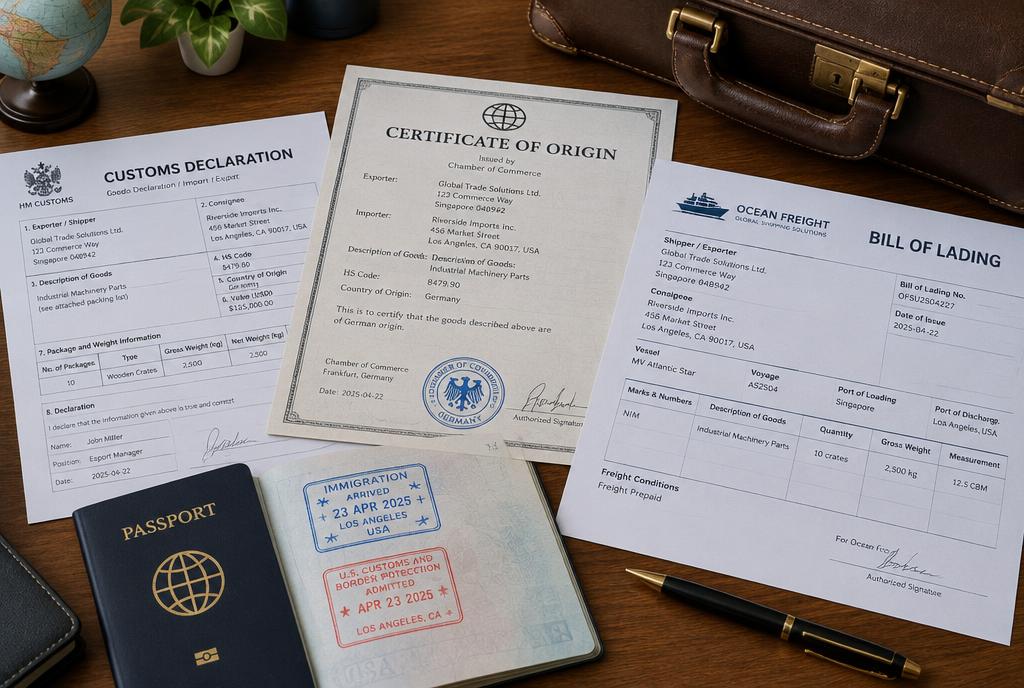
The core export documents are the same whichever term you use: a commercial invoice, a packing list, a bill of lading or air waybill, and a certificate of origin. What changes is who holds them, who needs them and which additional documents appear.
Under FOB, the bill of lading is typically issued to your nominated forwarder's order and you present it at destination. Under CIF, the supplier holds the freight contract and the insurance certificate becomes part of the set you receive. Under DDP, the import entry documents exist on the destination side and you may never see the bill of lading at all. If you are paying by letter of credit, the Incoterm has to match what the credit calls for, because a bank will reject a CIF credit presented with an FOB bill of lading.
Some destinations add their own layer. Several Gulf and Caribbean customs offices want the commercial invoice and certificate of origin stamped by a chamber of commerce or legalised before clearance, which adds working days before the container sails — so it has to be raised at the order stage rather than at dispatch. Mexican, Turkish and Russian entries expect importer details on the retail labelling as well as on the paperwork.
Choosing a term for your shipment
Our own quotations are issued FOB, CIF or DDP, with the named Indian gateway depending on the lane: Nhava Sheva (JNPT) carries most of our sailings, Mundra is the alternative west-coast service, Chennai serves east-bound Asia Pacific routings, and Delhi is our nearest international air gateway with Mumbai for consolidated air consignments. Inside India, delivery is by road with a GST invoice and an e-way bill rather than on an Incoterm at all.
What to confirm with your broker before you fix the term
Everything below is on the buyer's side of the line and no supplier should be answering it for you. Two of these can change which term is the right one, so confirm them before the quotation is accepted rather than after the booking is made.
- The tariff line for your heading and the duty rate in force on your arrival date — we do not classify on your behalf
- Whether a certificate of origin or a trade-agreement claim helps your entry
- Your importer registration: EORI in the EU and UK, an importer-of-record registration and customs bond in the US, equivalent registrations elsewhere
- How import VAT or GST is accounted for, and whether a DDP entry would block your recovery of it
- Who is named as the responsible economic operator on the product label in your market
- Your 3PL or distribution centre's inbound specification — pallet type, carton labels, weight limits and booking window
- Whether your entry needs a biosecurity packing declaration or any treatment certificate
| Your situation | Usual choice | Why |
|---|---|---|
| First import, no forwarder, small quantity | DDP | One counterparty and no clearance to arrange; check your VAT or GST recovery first |
| Established importer with a forwarder | FOB at a named Indian port | You see the real freight rate and can consolidate across suppliers |
| Consolidating several Indian suppliers | FOB or FCA | Lets your forwarder bring everything into one container at origin |
| Air freight for a deadline | FCA or CIP, not FOB | FOB is a sea term; FCA and CIP are the correct air equivalents |
| Letter of credit financing | Whatever the credit specifies, exactly | A mismatch between the credit and the documents is a rejected presentation |
| Corporate gifting to an office address | DDP or DAP | The goods have to reach a door, and no port collection is practical |
| High-value consignment | FOB plus your own all-risks policy | CIF's minimum cover is rarely adequate for finished leather goods |
Ready to start your order?
Send your brief and get a quotation and sampling plan within one working day.